

How to Make Pizza Diavola | Spicy Italian Homemade

The first time I ordered a Diavola in a small pizzeria off Via dei Tribunali in Naples, the waiter set it down with a quiet smile that I only understood once I took the first bite. The heat built slowly, then all at once, layered and complex rather than blunt, with the fat of the salame and the brightness of the tomato making it richer the hotter it got. I have been chasing that pizza ever since, and this recipe is the closest I have ever come.
What Is Pizza Diavola?
Pizza Diavola, which translates directly as devil’s pizza, is a classic Neapolitan pizza built on a foundation of San Marzano tomato sauce and fior di latte mozzarella, topped with spicy Italian salami and finished with Calabrian chili peppers or chili oil. It is not a modern creation and not a gimmick. It is a staple of southern Italian pizzerias that has appeared on menus across Naples and Calabria for generations.
The heat is the point, but it is never the only thing. A properly made Diavola balances fire with fat, acid with salt, and crunch with stretch. Every element on the pizza earns its place.
The Meaning Behind the Name: The Devil’s Pizza
The name is theatrical by design. Diavola in Italian means devil or diabolical, and the pizza lives up to it through the combination of deep red salame, the vivid orange of Calabrian chilies, and a heat that creeps up on you before it arrives in force. In some regional traditions the pizza is dressed to look like the devil himself, all red and glistening, with chilies arranged deliberately across the surface.
The spirit of the name matters as much as the heat level. This is a pizza meant to be bold, unapologetic, and a little theatrical. Making it timid defeats the whole point.
Pizza Diavola vs Pepperoni Pizza: What Is the Difference?
This is one of the most common questions I get, and the answer matters if you want to understand what you are actually making. Pepperoni is an American cured meat, heavily seasoned with paprika and fennel, with a specific processed texture and a smokiness that dominates everything around it. It is not Italian. You will not find it on a menu in Naples.
Salame piccante, the traditional topping for a Diavola, is a different animal entirely. It is made from coarsely ground pork with black pepper, chili, and regional spices, and it has a firmer texture, a more nuanced flavor, and a fat content that renders beautifully in a hot oven and pools in small orange puddles across the surface. The flavors are deeper, the heat is more complex, and the texture holds up where pepperoni can turn leathery.
If you want to explore the full world of cured Italian salami beyond the spicy version, our pizza salami recipe covers the milder Milano and Napoli styles in depth. Both are good in their own right. But if you are making a Pizza Diavola, use the right salami.
Ingredients for Pizza Diavola
Dough Ingredients
The dough for a Diavola is the same Neapolitan base that works for every great Italian pizza. Five hundred grams of Caputo 00 flour, 325 grams of water at room temperature, 10 grams of fine sea salt, and a third of a gram of instant dry yeast. Cold fermented for at least 24 hours, ideally 48 to 72, the dough develops the flavor and extensibility that makes it worth eating on its own.
Tomato Sauce Ingredients
A 400 gram can of whole San Marzano tomatoes, crushed by hand, with a teaspoon of fine sea salt. For a Diavola I sometimes add a very small drizzle of olive oil and a pinch of dried Calabrian oregano to the sauce, which adds a savory depth that reads as heat without being heat. This is a small change but a real one.
Cheese
Fior di latte is the standard. Torn into rough pieces, drained on paper towels for 20 minutes, and scattered across the sauce before the salami goes on. For special occasions I split it between fior di latte and a small amount of mozzarella di bufala added in the last minute of the bake, which adds a creamy, grassy note that plays beautifully against the spice.
Spicy Toppings
The toppings are where the Diavola lives or dies. Sliced salame piccante, whole or halved Calabrian chili peppers (fresh or pickled), and a finishing drizzle of chili infused olive oil after the bake. Nduja, the spreadable Calabrian pork sausage, is the optional upgrade that takes the whole pizza somewhere extraordinary.
Choosing the Right Spicy Salami
Salame Piccante
Salame piccante is the starting point and the most widely available option. Look for a southern Italian style with visible fat marbling and a dark, rust red color. It should taste spiced and complex, not just hot. Thin sliced is fine but not mandatory. I prefer slices about 2 to 3 millimeters thick, which gives them enough body to hold up in the oven without curling into cups.
Nduja: The Spreadable Calabrian Sausage
Nduja is one of the great treasures of Calabrian cuisine and one of the best pizza toppings in the world. It is a soft, spreadable sausage made from pork fat, meat, and Calabrian chilies, and it melts into the pizza as it bakes, pooling across the cheese like a vivid orange sauce. It adds tremendous richness, a fruity chili heat, and a pork fat backdrop that makes the whole pizza taste more deeply savory.
A teaspoon of nduja dotted across the surface of a Diavola, on top of the salame, transforms the pizza. It is the single upgrade I recommend above everything else on this list.
Soppressata Piccante
Soppressata is a more rustic, coarsely ground cured sausage from Calabria and Basilicata. The piccante version has a bold, direct heat that hits fast and fades cleanly. It is less common than salame piccante outside of Italy but worth seeking out. If you find it, use it on at least one pizza before mixing with anything else. The flavor is assertive and deserves space to show itself.
Can You Use Pepperoni Instead?
You can, and the pizza will be good. But call it a pepperoni pizza, not a Diavola. The flavor profile, the texture, and the heat character are different enough that the two dishes are not interchangeable. If salame piccante is genuinely unavailable, use spicy soppressata or Spanish chorizo as a closer substitute. Both are pork based, properly spiced, and behave better in a hot oven than pepperoni does.
The Role of Calabrian Chili Peppers
Fresh vs Dried Calabrian Chilies
Fresh Calabrian chilies have a bright, fruity heat with a faint sweetness at the edges. Sliced thin and scattered raw across the pizza before baking, they soften in the oven and their heat infuses into the cheese and sauce. Dried Calabrian chilies are more concentrated and a bit smokier, better suited to the chili oil than to sitting directly on the pizza.
My preference for the pizza itself is the pickled Calabrian chilies packed in oil, which you can find in most Italian delis and specialty grocers. They have a mild vinegar brightness that cuts through the richness of the pork fat and adds a pop of acidity that the pizza genuinely needs.
Using Chili Oil for Extra Heat
A finishing drizzle of good chili oil after the pizza comes out of the oven is not optional in my kitchen. It adds heat, gloss, and an aromatic sheen that makes the pizza look as good as it tastes. Make your own by warming good olive oil with dried Calabrian chili flakes for five minutes, then cooling completely before using. Store bought chili oil works but tends to be blunter and less fragrant.
Substitutes if Calabrian Chilies Are Unavailable
If you cannot source Calabrian chilies, the closest substitutes in order are: Fresno chilies, which have a similar fruity heat; Aleppo pepper flakes, which are milder but share the same faint sweetness; and regular dried red chili flakes as a fallback. Korean gochugaru is an unexpected but genuinely good substitute for the oil, with a fruity heat and a deep red color that reads visually just like the real thing.
Best Cheese for Pizza Diavola
Fior di Latte vs Buffalo Mozzarella
Fior di latte is the right call for a Diavola. Its mild, slightly milky flavor does not fight the spice but creates a creamy backdrop that lets the salami and chilies lead. Buffalo mozzarella is richer and more flavorful, which is a good thing in isolation but can muddy the heat when the whole pizza is already complex. If you use bufala, use less of it.
Both must be drained for at least 20 minutes before building the pizza. This is not optional. Wet cheese on a spicy pizza produces a soggy, muddled result that wastes every other ingredient.
Should You Add Parmesan or Pecorino?
A light dusting of finely grated pecorino romano after the pizza comes out of the oven is a small addition that makes a real difference. The sheep’s milk sharpness of pecorino echoes the salt of the salami and bridges the gap between the heat and the creamy cheese. Parmesan works too but is less southern Italian in character. Either way, use a light hand. A dusting, not a coating.
Equipment You’ll Need
Pizza Stone, Steel, or Oven
For a home oven, a pizza steel is the best option. It retains and radiates more heat than stone, gives you a crisper bottom, and heats more evenly. Preheat it in the top third of your oven at maximum temperature for at least 45 minutes before baking. If you have a wood fired oven, the Diavola is spectacular in it. The char adds a smoke note that plays brilliantly with the Calabrian heat.
Pizza Peel
A wooden peel for launching and a metal one for retrieving. Flour the wooden peel well and build the pizza fast. The longer the raw dough sits on the peel, the more it absorbs moisture from the sauce and the harder it is to slide.
Other Useful Tools
A kitchen scale for dough ingredients, oiled proofing containers with lids, a dough scraper, an infrared thermometer if you have a wood fired oven, and a pizza cutter or kitchen shears. A small offset spatula helps spread the nduja in controlled dollops without tearing the cheese underneath.
How to Make Pizza Diavola Dough
Step 1: Mixing the Ingredients
Combine the flour and water in a large bowl and stir with your hand until no dry flour remains. Cover and rest for 30 minutes. This autolyse step is quiet and easy and develops gluten without effort.
After the rest, add the salt and yeast and squeeze through the dough with your fingers until everything is fully incorporated.
Step 2: Kneading to Develop Gluten
Knead using a stretch and fold technique in the bowl, lifting one side of the dough and folding it over the center, rotating a quarter turn between folds. Work for about 5 minutes until the dough is smooth, slightly tacky, and springs back when poked.
Step 3: Bulk Fermentation
Cover and rest at room temperature for one hour. The dough will relax noticeably without doubling in size. This is normal and correct.
Step 4: Cold Proofing for Authentic Flavor
Divide into 2 balls of roughly 420 grams each for 12 to 14 inch pizzas, or 4 balls of roughly 210 grams for 10 inch pies. Shape each into a tight, smooth ball by tucking the edges underneath, then place in lightly oiled, lidded containers. Refrigerate for 24 to 72 hours.
The cold proof is where the flavor develops. A 24 hour proof gives you a clean, neutral dough with good extensibility. A 72 hour proof gives you the faintly tangy, complex dough that makes people ask what your secret is.
Step 5: Shaping the Dough Balls
Take the dough out of the fridge two hours before baking. Cold dough tears and fights you. Room temperature dough stretches with almost no resistance. Look for dough balls that are glossy, jiggly, and dotted with small bubbles just under the surface. That is a well proofed ball.
Preparing the San Marzano Tomato Sauce
Classic No Cook Italian Sauce
Crush the San Marzano tomatoes by hand into a bowl until you have a rough, textured purée. Add fine sea salt, a small drizzle of olive oil, and if you want the authentic Diavola edge, a pinch of dried Calabrian chili flakes. Stir and taste. The sauce should taste bright, slightly acidic, and pleasantly salty before it goes on the pizza.
Seasoning for Diavola: Garlic, Oregano, Chili
Some Diavola recipes use a garlic rubbed sauce, running a raw clove around the bowl before adding the tomatoes. I do this occasionally, and it adds a faint background warmth that amplifies the heat of the salami without announcing itself. Dried oregano, specifically the wild Sicilian or Greek variety on the branch, stirred into the sauce before topping adds an herbal note that the Diavola needs. Fresh oregano is a different flavor entirely and does not work the same way here.
How to Assemble Pizza Diavola
Hand Stretching the Dough
Flour the work surface lightly. Press a dough ball flat with your fingertips from the center outward, building the rim by pushing air to the edges. Lift and drape over your knuckles, rotating gently until you have a round 10 to 12 inches across. Move slowly and let the dough do the work.
Spreading the Sauce
Three tablespoons of sauce, spread in a thin spiral with the back of a spoon, leaving a finger width border. For a Diavola the sauce layer should be thinner than for a Margherita. The salami releases fat as it cooks, and a generous sauce layer combined with melting pork fat creates exactly the soggy middle you are trying to avoid.
Layering the Mozzarella
Scatter the drained fior di latte in loose pieces across the sauce. Leave visible gaps. The cheese will spread as it melts, and gaps give the sauce room to breathe and develop flavor.
Arranging Spicy Salami and Chilies
Lay the salame piccante slices across the cheese, slightly overlapping but not stacked. Scatter the sliced Calabrian chilies over and around the salami. If you are using pickled chilies in oil, give them a quick pat dry before adding to avoid excess moisture on the surface.
Finishing with Nduja or Chili Oil
If using nduja, dot small half teaspoon amounts across the surface of the pizza just before it goes into the oven. It will melt and spread during the bake, turning the entire surface glossy and orange. After the bake, finish with a thin drizzle of chili infused olive oil. This is the step most home cooks skip and the one that makes the biggest visual and flavor difference.
Baking Pizza Diavola to Perfection
Ideal Oven Temperature
Maximum your home oven will go, typically 500 to 550 degrees Fahrenheit, with a pizza steel preheated for at least 45 minutes. In a wood fired oven, 850 degrees on the floor. The high heat is what renders the salami fat, chars the chili edges slightly, and gives the cornicione its lift and color.
Bake Time and Crust Cues
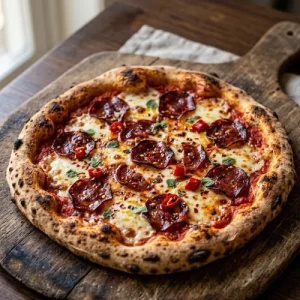
In a home oven on a steel, the pizza bakes in 8 to 10 minutes. Watch for the cornicione to puff, deepen in color, and show the first brown spots on the rim. The salami should be slightly darker at the edges with small pools of rendered fat across the surface. The cheese should be fully melted with a few golden spots. If you see the chilies beginning to char at the very edges, that is ideal. If they are going black, pull immediately.
Wood Fired vs Home Oven Results
In a wood fired oven the bake takes 60 to 90 seconds and the result is different in every visible and tasteable way. The cornicione leopards, the salami crisps slightly at the edges while staying tender in the middle, the chili oil sizzles when it hits the hot surface, and the smoke from the wood adds a dimension no home oven can replicate. If you have access to a wood fired oven, the Diavola is one of the best possible pizzas to bake in it.
Expert Tips for an Authentic Diavola
The single most impactful upgrade you can make is the nduja. A small amount goes further than you think, and it changes the texture, aroma, and heat profile of the whole pizza in a way nothing else matches.
Do not add the chili oil before baking. Add it after. The compounds that give chili oil its fragrance are volatile and burn off quickly in a hot oven, leaving you with heat but none of the aroma. The finishing drizzle preserves the full aromatic character.
Buy your salame piccante whole from a deli and slice it yourself if possible. Pre sliced salami loses moisture quickly and tends to go leathery in the oven. Fresh cut slices have better fat content and better texture.
If the pizza is coming out too spicy for the group you are feeding, a drizzle of raw local honey after the bake cuts the heat dramatically while adding a sweetness that actually improves the pizza rather than dumbing it down. This is a variation worth trying even if the heat level is fine.
Preheat the steel or stone longer than you think necessary. Forty five minutes is the minimum. An hour is better. The thermal mass needs to be fully saturated before you launch, and cutting this short is the most common reason home oven pizzas have soft, pale bottoms.
How to Balance the Heat
Adjusting Spice for Mild Palates
Use fewer Calabrian chilies and skip the nduja entirely. Substitute a sweet salame or even a mild Italian sausage for part of the salame piccante. A drizzle of raw honey after the bake will soften the residual heat further without killing the character of the pizza.
Removing the seeds from fresh chilies before adding them reduces the heat significantly while keeping the flavor. Most of the capsaicin lives in the pith and seeds, not the flesh.
Making It Extra Hot for Spice Lovers
Add nduja generously, increase the Calabrian chilies, and finish with a hot chili oil rather than a mild one. A pinch of dried Calabrian chili flakes scattered directly over the cheese before baking adds heat that blooms in the oven and becomes part of the fabric of the pizza rather than sitting on the surface.
For genuine heat, slice two or three fresh Fresno or serrano chilies thin and add them alongside the Calabrian ones. The two varieties have different capsaicin compounds and different heat curves, which creates a more complex, layered heat rather than a single blunt note.
Common Mistakes to Avoid
Using the Wrong Salami
Generic sliced deli salami does not work here. The fat content is different, the spice is milder, and the texture turns rubbery in the oven. Use salame piccante, soppressata piccante, or nduja, in that order of preference.
Overloading with Toppings
More is not more on a Diavola. The salami is already intensely flavored. The chilies are sharp. The nduja is rich. Adding more toppings on top of those creates a muddy, overwhelming pizza where nothing reads clearly.
Burning the Chilies
Calabrian chilies go from perfect to charred quickly in a very hot oven. Pickled chilies in oil are more forgiving than fresh ones. If you are baking in a wood fired oven or at maximum home oven temperature, add the fresh chilies with about two minutes to go rather than from the start.
Soggy Crust Problems
Three causes, always. Wet cheese that was not drained. Too much sauce on the base. Or a cooking surface that was not hot enough. Address all three and the problem disappears.
Popular Pizza Diavola Variations
Classic Diavola
San Marzano sauce, fior di latte, salame piccante, Calabrian chili peppers, finishing chili oil. This is the version to master first and the one that defines the category.
Diavola with Nduja
Everything in the classic version plus generous dots of nduja pressed between the salami slices before baking. The nduja melts across the surface and turns the entire pizza into something frankly incredible. This is my personal house version and the one I make most often for people who love spice.
Diavola Bianca: White Diavola
Skip the tomato sauce entirely. Brush the dough with olive oil, scatter fior di latte and a thin layer of crème fraîche. Top with salame piccante and Calabrian chilies, bake, then finish with fresh arugula, a squeeze of lemon, and a drizzle of chili oil. The absence of tomato makes the heat of the salami and the creaminess of the cheese read more clearly. It is a sophisticated variation that surprises people every time.
Diavola with Honey
Classic Diavola, fully baked, finished with a thin drizzle of raw wildflower or chestnut honey across the surface just before serving. The honey amplifies the heat rather than canceling it, and the sweet and spicy combination is genuinely irresistible. I have served this version to people who claim they do not like spicy food, and they eat the whole pizza.
Diavola with Olives and Capers
Add a scatter of Taggiasca olives and brined capers before baking. Both add a briny, acidic depth that plays well against the fat of the salami. This variation leans more toward the southern Italian fishing village tradition, where salty preserved ingredients are layered generously on everything.
If you enjoy a generously topped pizza with olives, mushrooms, and cured meats arranged together, our pizza capricciosa recipe is the natural next pizza to try.
Serving Suggestions
Best Drinks to Pair
A chilled Aglianico from Campania or Basilicata is the regional match. Its earthy, dark fruit character and firm tannins handle the heat and the fat of the salami without being overwhelmed. For something lighter, a cold Peroni or Moretti lager cuts the spice and refreshes the palate between bites. A sparkling water with a lemon wedge is the simplest and often the best choice when the heat is genuinely high.
Side Dishes and Salads
A simple green salad with bitter leaves, lemon, and good olive oil is the right companion. Arugula, radicchio, or Belgian endive all have the bitterness needed to balance the richness of the pizza. Avoid anything creamy or heavily dressed. The Diavola is already rich and complex and does not need competition.
Storage and Reheating Instructions
Storing Leftover Diavola
Leftover slices keep in the fridge for up to 2 days in a covered container in a single layer. The salami will firm up slightly in the cold, which is fine. Avoid plastic wrap directly on the cheese surface, which makes the texture gummy.
Best Way to Reheat Without Losing Crispness
A dry skillet over medium heat for 2 to 3 minutes. Place the slice crust side down, cover the pan with a lid for the first minute to trap steam and melt the cheese, then remove the lid for the final minute to crisp the base. The result is nearly as good as fresh. The microwave is the wrong tool for this pizza at any temperature.
Can You Freeze It?
Cooked pizza freezes adequately for up to one month. Wrap slices individually in parchment and then foil, and reheat from frozen in a 400 degree oven for 8 to 10 minutes. Raw dough balls freeze well for up to three months in oiled bags. Thaw overnight in the fridge and bring to room temperature for two hours before shaping.
Pizza Diavola Recipe

Equipment
- Pizza steel ya pizza stone
- Wooden pizza peel
- Metal pizza peel
- Kitchen scale
- Oiled proofing containers with lids
- Dough scraper
- Pizza cutter ya kitchen shears
- Small offset spatula
- Infrared thermometer
Ingredients
- 500 grams Caputo 00 flour 325 grams water at room temperature 10 grams fine sea salt 0.3 grams instant dry yeast about an eighth of a teaspoon
- 400 gram can whole San Marzano tomatoes ideally DOP 1 teaspoon fine sea salt 1 small drizzle extra virgin olive oil Pinch of dried Calabrian oregano (optional but recommended)
- 80 grams fior di latte torn and drained 20 minutes on paper towels 70 to 80 grams salame piccante, sliced 2 to 3 millimeters thick 6 to 8 Calabrian chili peppers, sliced (fresh, dried, or pickled in oil) 1 heaped teaspoon nduja (optional but strongly recommended) 1 teaspoon chili infused olive oil, for finishing Small pinch of finely grated pecorino romano, for finishing
Instructions
Prepare the Dough
- Combine flour and water in a large bowl. Stir with your hand until no dry flour remains. Cover and rest 30 minutes (autolyse).
- Add salt and yeast. Squeeze through the dough with your fingers until fully incorporated.
- Knead in the bowl using stretch and fold for 5 minutes until smooth and slightly tacky.
- Cover and bulk ferment at room temperature for 1 hour.
- Divide into 2 balls of roughly 420 grams each. Shape into tight smooth balls by tucking the edges underneath.
- Place each in a lightly oiled container with a lid. Refrigerate 24 to 72 hours.
- Remove from the fridge 2 hours before baking.
Make the Tomato Sauce
- Crush the San Marzano tomatoes by hand into a bowl until you have a textured purée.
- Add salt, olive oil, and dried oregano. Stir and taste. The sauce should be bright, salty, and slightly acidic.
- Refrigerate until ready to use.
Assemble the Pizza
- Tear the fior di latte into rough pieces. Drain on paper towels for 20 minutes. Pat dry if still wet.
- Flour the work surface. Press a dough ball flat from center outward with your fingertips. Lift and stretch over your knuckles, rotating gently, until you have a 12 to 14 inch round.
- Transfer to a well floured peel. Spread 3 tablespoons of sauce in a thin spiral, leaving a finger width border.
- Scatter the drained fior di latte across the sauce, leaving gaps.
- Lay salame piccante slices across the cheese.
- Scatter the Calabrian chili slices across the salami.
- Dot small amounts of nduja across the surface if using.
- Shake the peel to confirm the pizza is loose before launching.
Bake and Serve
- Home oven: preheat pizza steel at maximum temperature (500 to 550°F) for at least 45 to 60 minutes. Slide pizza onto the steel and bake 8 to 10 minutes until the cornicione is puffed and beginning to char, the cheese is fully melted and golden in spots, and the salami edges are slightly darkened.
- Wood fired oven: bake at 850°F on the floor for 60 to 90 seconds, rotating every 20 seconds with a turning peel.
- Pull the pizza and immediately drizzle with chili infused olive oil.
- Dust lightly with pecorino romano.
- Slice with a wheel or kitchen shears. Serve immediately.
Notes
- Drain the mozzarella for the full 20 minutes. Wet cheese is the most common cause of a soggy Diavola, and no oven temperature fixes it after the fact.
- Add the chili oil after the bake, not before. The aromatic compounds that make chili oil fragrant are volatile and burn off in the oven, leaving heat without aroma.
- If using fresh Calabrian chilies in a very hot oven, add them in the last 2 minutes of baking. Fresh chilies burn faster than pickled ones.
- The nduja is optional only in that the pizza is still great without it. Once you try it with nduja, you will not want to go without.
- A finishing drizzle of raw honey over a completed Diavola is not a gimmick. The sweetness amplifies the heat rather than suppressing it and adds a caramel note that pairs beautifully with the pork fat and tomato.

The tip about adding nduja and drizzling the chili oil after the bake completely transformed my homemade pizza game. A true 5-star masterclass!